


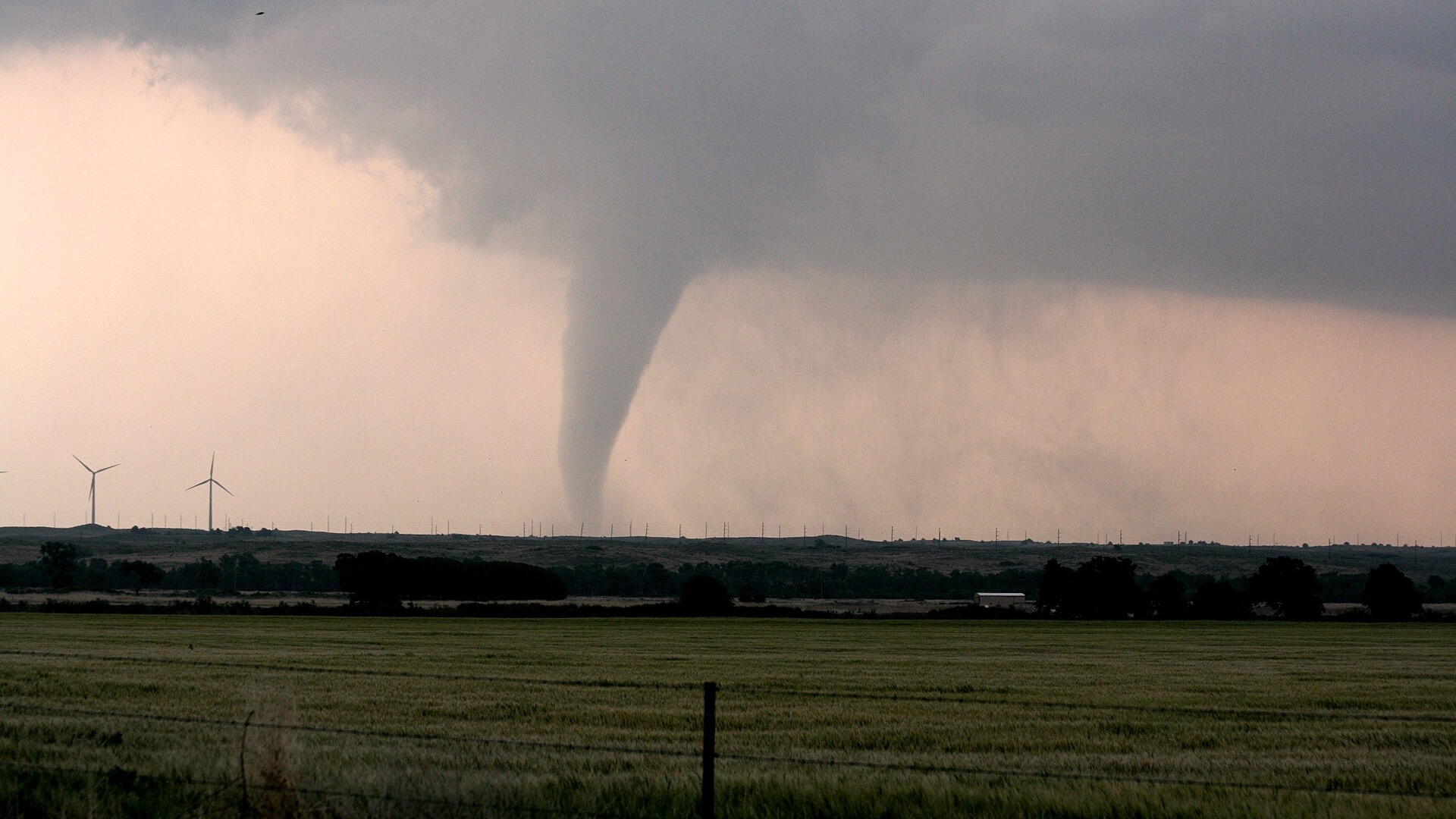
The reference page for the strongest tornadoes on Earth — updated as ratings change.
Has there been an EF5 tornado in 2026? No. As of this writing, no tornado in 2026 has been rated EF5. The most recent EF5 in the United States remains the Enderlin, North Dakota tornado of June 20, 2025 — the storm that ended a twelve-year drought at the top of the scale. This page is the standing record: every EF5 since the scale began, what the rating actually measures, why the top of the scale went quiet for twelve years, and what the current year looks like.
An EF5 is a tornado whose damage indicates winds over 200 mph — the top of the Enhanced Fujita (EF) scale that the National Weather Service adopted on February 1, 2007, replacing Dr. Ted Fujita's original F-scale from 1971.
The detail most people miss: tornadoes are rated by damage, not by measured wind. Survey teams walk the path after the storm and match what they find against standardized damage indicators. The signature of EF5 damage is a well-built, well-anchored home swept completely off its foundation — a clean slab. That has two consequences worth understanding:
Enderlin is the clearest recent illustration of both points. It was initially rated EF3, and only upgraded to EF5 months later, after surveyors assessed toppled, fully loaded rail hopper cars and an empty tanker car thrown hundreds of feet — evidence of winds far beyond what the surrounding structures could demonstrate. The rating is a measurement of what a tornado hit, not simply of how strong it was.
Ten US tornadoes have earned the EF5 rating since the Enhanced Fujita scale took effect:
Four of the ten came on a single April afternoon in 2011 — a concentration of violence unmatched in the EF era.
The original Fujita scale rated roughly 50 US tornadoes F5 between 1950 and 2007. The names that still define the category:
Counting both scales, roughly 60 tornadoes have earned the top rating since official US records began in 1950 — averaging less than one per year.
Between Moore in May 2013 and the Enderlin tornado of June 2025, not one US tornado was rated EF5 — the longest gap at the top of the scale in the official record. The drought had two competing explanations. One is meteorological luck: violent tornadoes kept missing the well-built structures needed to prove 200+ mph damage, and several high-end EF4 ratings from those years (including tornadoes surveyed within a few mph of the line) are still argued about. The other is rating conservatism: many researchers contend survey standards effectively tightened, and that storms from the drought years would have been rated EF5 a decade earlier.
Enderlin is a case study in why the question is hard to settle. The tornado was violent by any description, but its EF5 rating hinged on a piece of evidence most tornadoes never provide. Without that rail-car evidence, it could well have remained an EF3 in the record — which is exactly the ambiguity the drought debate turns on.
Track every significant tornado as it happens
DisasterAWARE turns NWS damage surveys, warning polygons, and storm reports into decision-ready intelligence — for every hazard, worldwide.
This section is updated when NWS damage surveys change the record. Because ratings are sometimes revised upward months after an event — as Enderlin was — the current-year status here reflects official ratings as they stand today, not preliminary survey data.
An EF5 is not just a bigger EF4. At 200+ mph, engineered safety margins fail: reinforced buildings lose structural integrity, mobile assets become projectiles, and the survivable options narrow to purpose-built shelters and below-grade refuge. For organizations with facilities, employees, or supply chains in tornado country, the operational questions are the ones damage surveys answer too late: which sites sit in a warned path right now, what did the storm actually hit, and what does the historical record say about any given location's exposure.
That's the gap DisasterAWARE closes. Warning polygons, local storm reports, and NWS damage-survey data stream into the platform as structured events, and decades of verified tornado history are queryable per location through Historical Event Intelligence. City-level views like tornado risk in Phoenix or Boston put live alerts and historical exposure on one page, and the tornado monitoring guide covers the real-time alerting workflow.
Explore the historical record
Decades of reconstructed, verified catastrophes — browse the Historical Event Intelligence overview, or request sample data for your own portfolio.
Has there been an EF5 tornado in 2026? No. No tornado in 2026 has been rated EF5. The strongest US tornado of the year so far, through Vance Air Force Base and Enid, Oklahoma on April 23, was rated EF4.
When was the last EF5 tornado? June 20, 2025, at Enderlin, North Dakota — the tornado that ended the twelve-year "EF5 drought." Before that, the last EF5 was the Moore, Oklahoma tornado of May 20, 2013.
How many EF5 tornadoes have there been? Ten in the United States since the Enhanced Fujita scale took effect in February 2007. Counting the original F-scale era, roughly 60 US tornadoes have earned the top rating since official records began in 1950 — fewer than one per year on average.
What wind speed is an EF5? Damage indicating winds over 200 mph. Because ratings are based on surveyed damage rather than measured wind, a tornado must strike well-built structures to prove EF5 intensity — one reason the rating is so rare.
What is the strongest tornado ever recorded? No single tornado holds an undisputed wind record. Only radar has captured winds this strong, and the DOW team counts three tornadoes above 300 mph: Bridge Creek–Moore, Oklahoma (May 3, 1999; first reported at 302 mph, revised to 321 mph in 2021), El Reno, Oklahoma (May 31, 2013; 291–336 mph reported by Wurman et al. 2014 and 313 mph by Bluestein et al. 2015, in very small, fast-moving sub-vortices) and Greenfield, Iowa (May 21, 2024; 309–318 mph). These are radar-derived values measured above the ground, not anemometer readings or damage ratings, and each carries uncertainty (FARM/Doppler on Wheels statement, June 23, 2024; Wurman et al. 2007 and 2021). By death toll, the 1925 Tri-State Tornado, which killed 695 people across three states.
What's the difference between F5 and EF5? The original Fujita scale (1971) estimated winds from damage with F5 defined as 261–318 mph. The Enhanced Fujita scale (2007) recalibrated the wind estimates against engineering studies — EF5 means winds over 200 mph, with far more rigorous damage indicators. The storms are comparably violent; the science of estimating their winds improved.













-min.png)
.png)

.png)



Decision-ready intelligence for understanding what's happening, what is impacted, and what to do next. Global hazard, severe weather, catastrophe, and physical risk intelligence trusted by governments, enterprises, insurers, humanitarian organizations, and technology platforms worldwide.
Request DemoContact Us

