


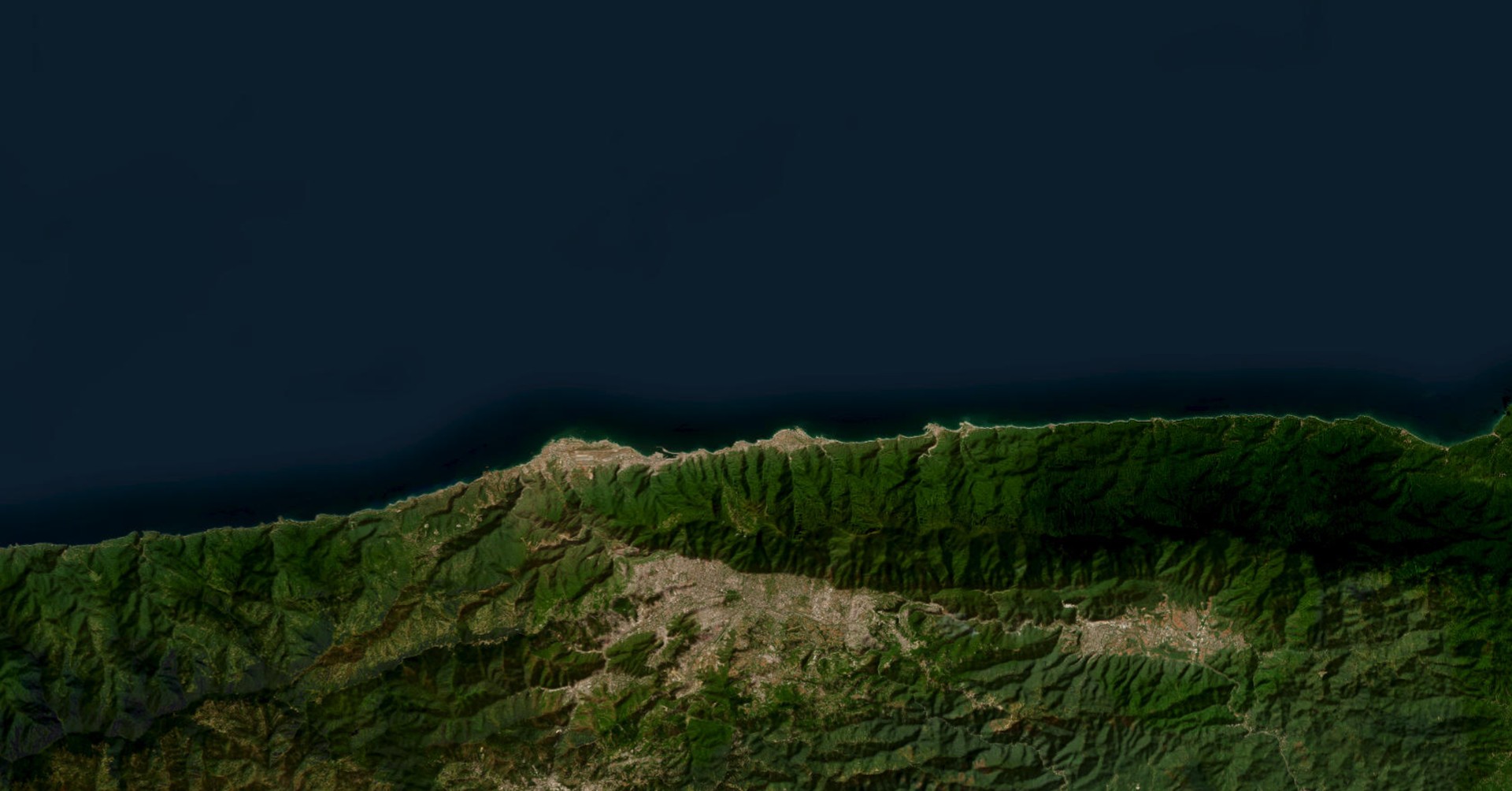
Two large earthquakes struck northern Venezuela 32 seconds apart on June 24, 2026. Together they ruptured roughly 200 kilometers of fault, from inland Yaracuy east to beneath the La Guaira coast, where the second and larger shock began. The official death toll stands at 6,509 people.
Correction and update, September 25, 2026. The first version of this article, published June 30, was built on the U.S. Geological Survey's early location for the M7.5 earthquake, which placed it inland near Yumare and Morón. USGS has since moved it to about 20 km west of Catia La Mar, on the La Guaira coast. That change removes the original central claim: that the deaths happened "180 kilometers from the epicenter" and so had to be explained mainly by soft coastal soils. We have rewritten the article around the current USGS data. We also corrected these points:
• The gap between the two earthquakes is 32 seconds, not 39.
• The fault is the San Sebastián fault system, not El Pilar–Oca-Ancón.
• The death toll is now 6,509 (official, August 24), not 1,450.
• We replaced the June aftershock probabilities with USGS's current forecast; one of them ("43% chance of an M6+") could not have been correct.
• Martinique is about 800 km from the epicenter, not 1,700.
• USGS's fatality estimate (PAGER, computed on the preliminary location) put the most likely range in the tens of thousands, not merely "extending into five figures".
• We removed the table of people exposed to each shaking level: USGS has not yet recomputed it on the relocated earthquake.
• The 1967 Caracas earthquake was M6.6 with about 240 deaths, and its epicenter was near the coast, about 13 km from the 2026 M7.5, not "about 35 miles offshore".
We also removed several figures from humanitarian situation reports that we could not re-check against publicly available copies, and a map image that showed the old location.
On the evening of June 24, 2026, northern Venezuela was hit by two major earthquakes in quick succession. The first, magnitude 7.2, struck at 6:04 p.m. local time about 20 kilometers east of San Felipe in Yaracuy state, in a lightly populated inland area. The second, magnitude 7.5, followed 32 seconds later, according to the U.S. Geological Survey (USGS). It began about 20 kilometers west of Catia La Mar, just off the coast of La Guaira state. USGS models the two shocks as one continuous rupture, running from Yaracuy east to beyond Naiguatá. The M7.5 began about 30 seconds into it, and the eastern part of that rupture lies beneath the La Guaira shoreline.
That eastern end of the rupture is the key to this disaster. The coast above it is home to Catia La Mar, Macuto, Caraballeda, Los Corales and Naiguatá: rows of mid-rise and high-rise concrete apartment blocks on a narrow strip between the Caribbean and the mountains. That coast is where most of the dying happened. As of the last official update on August 24, at least 6,509 people had died, and the number of people missing is still disputed.
This article explains what happened, why the damage concentrated where it did, and what the numbers do and do not tell us. Where a figure comes from a model rather than a count, we say so.
The map shows both epicenters at their current USGS locations, the approximate area of the fault that broke according to the USGS rupture model, the La Guaira coastal communities where damage was heaviest, and the affected hospital network. Click any point for detail.
Open map full screen in a new tab ↗
Map data: USGS (event locations and rupture model), UN OCHA, and published damage reporting. Epicenters use the USGS catalog locations as of September 2026.
Northern Venezuela sits on the boundary between the Caribbean Plate and the South American Plate. The Caribbean Plate moves east past South America at about 20 millimeters a year. Two large systems of faults take up most of that motion, and on both of them the far side of the fault moves to the right (right-lateral faults). One is the San Sebastián fault system, which runs east–west along the coast, mostly just offshore. The other is the Boconó fault system, which runs southwest into the Venezuelan Andes (USGS).
The June 24 earthquakes were a doublet: two earthquakes of similar size, close together in time and place. The first, M7.2, broke onshore in Yaracuy. About 32 seconds later the M7.5 began about 150 kilometers to the east, just off the La Guaira coast.
Seismologists have modeled the fault slip in different ways, but they agree on the overall picture:
In plain terms, La Guaira was not far from the earthquake: the eastern part of the rupture ran beneath its coastline. The models differ in detail: USGS puts its largest slip offshore, west of the M7.5 epicenter and of the worst-hit towns, while INGV's largest slip lies nearer Caracas. Both put the coast close to where much of the energy was released.
The shaking reached far beyond Venezuela. It was felt in Bogotá, across the ABC islands, in Santo Domingo and Puerto Rico, and in northern Brazil as far as Manaus, about 1,700 kilometers from the M7.5 epicenter. A tsunami advisory for the Dominican Republic, Puerto Rico and the Virgin Islands was issued and later cancelled. Waves were measured at about 4 centimeters at Isla de Mona and Yabucoa, Puerto Rico, and 2 centimeters at Fort-de-France, Martinique.
USGS's PAGER system (Prompt Assessment of Global Earthquakes for Response) issued a red alert for both earthquakes. That means high casualties and extensive damage are probable. PAGER gives its fatality estimate as probabilities for ranges of deaths. For the M7.5 alone, its latest version (July 13) gives the figures below. That version was computed on the preliminary inland location of the M7.5 and has not been rerun since the relocation:
USGS calculates these estimates for each earthquake separately, so the two cannot be added together. The confirmed toll of 6,509 falls in PAGER's 1,000–10,000 range. PAGER's red alert, issued on the day, correctly signaled a major disaster.
The USGS ShakeMap for the M7.5, updated after the relocation (version 16, September 7), puts peak shaking at MMI IX ("violent"). USGS has not yet recomputed its estimates of how many people lived in each shaking band on the relocated rupture, so we do not quote them.
The biggest single factor is geography. The M7.5 started about 21 kilometers from Catia La Mar, and in the USGS model the eastern part of the rupture runs beneath the La Guaira shoreline. The damage pattern matches. Risk Frontiers describes "a very strong concentration of damage along a 40 km long coastal region north of the city of Caracas." Satellite analysis of that stretch, covering Catia La Mar, La Guaira, Macuto, Caraballeda and Naiguatá, estimated about 59,000 damaged buildings.
The inland M7.2 was also large, but it struck a far less densely built area. Official and municipal counts from the states nearest it are much smaller: 19 dead in Carabobo, and 12 in the collapse of a single building in Tucacas, Falcón. In the Veroes area near the M7.2 epicenter, 25 homes collapsed and more than 2,600 were damaged. That damage is serious, but it is a different order of magnitude from the coast.
When a fault breaks in one direction, shaking is strongest ahead of the moving rupture. Seismologists call this rupture directivity. The energy piles up into short, powerful pulses. According to Risk Frontiers, mid-rise and high-rise buildings near the fault, which sway slowly (a few seconds per swing), "would have been subjected to extremely strong pulses of ground motion." That describes La Guaira's coastal apartment towers. In the USGS and INGV models the combined rupture moved east, toward Caracas, so the coastal towers lay ahead of it. Risk Frontiers' analysis predates USGS's relocation of the M7.5, but its directivity argument depends only on the rupture moving east.
Engineers cited in post-event reporting pointed to several problems:
Risk Frontiers identifies the main vulnerable types as concrete-frame buildings with brittle clay-tile or unreinforced masonry walls, from low-rise non-engineered homes to mid-rise and high-rise apartment blocks. Rescuers also reported finding walls made of styrofoam and concrete. Structures like these can fail under shaking that well-built ones survive.
The La Guaira coast is steep mountain rising straight from the sea. USGS scientists who studied the 1999 Vargas disaster noted that the fans of sediment washed out of mountain streams "are the only areas where slopes are not too steep to build," and the towns are built on them. Loose sediments like these can amplify shaking. That effect is well documented in Caracas: after the 1967 earthquake, engineers linked the collapses in Los Palos Grandes to the depth of the soft sediment beneath them. How much soil amplification added to the 2026 losses has not yet been measured in any study we could find. We treat it as a likely contributor, not the main cause.
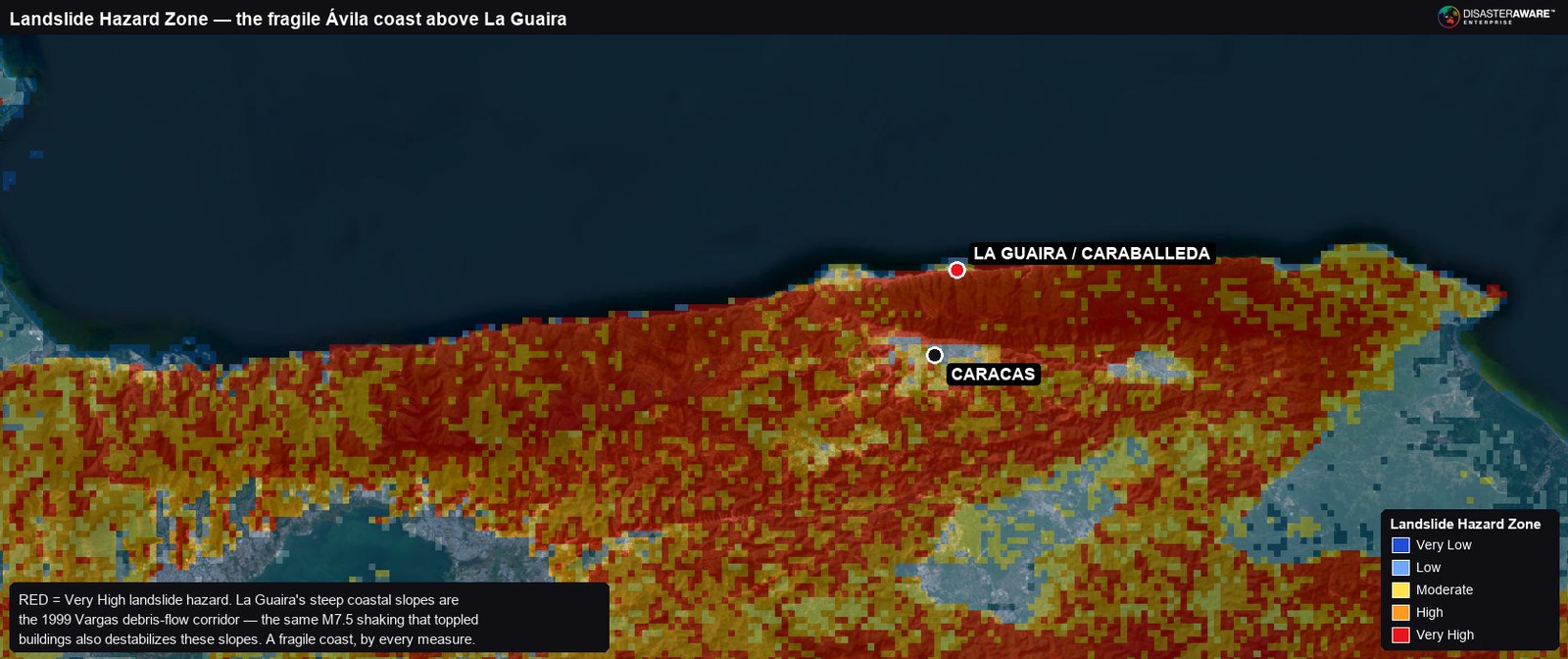
DisasterAWARE's Landslide Hazard Zone layer over the La Guaira coast. The steep Ávila slopes behind the towns rate Very High (red). This is the corridor where the 1999 Vargas debris flows came down.
The two quakes also came almost back to back. It is plausible that the M7.2 weakened some buildings before the M7.5 arrived half a minute later. Landslide scientist Dave Petley judged that the first shock "probably" increased the second one's impact. No study we have seen yet measures how large that effect was.
1967. On July 29, 1967, an M6.6 earthquake struck offshore of this same central coast. Its listed epicenter is about 13 kilometers from the 2026 M7.5 epicenter. About 240 people died (USGS; other estimates range from 225 to 300). Four apartment buildings 10 to 12 stories tall collapsed in Caracas's Altamira and Los Palos Grandes districts. In Caraballeda, the Charaima building partly collapsed and the Macuto Sheraton was heavily damaged. Soil-and-damage studies of that earthquake became textbook material on how deep, soft sediments can raise the damage to tall buildings.
1999. In December 1999, torrential rain triggered debris flows down the Ávila slopes onto the same coastal fans, killing an estimated 19,000 people, according to USGS (estimates vary widely). That disaster was caused by rain, not an earthquake. But it rebuilt the fans that towns like Caraballeda stand on, and it set off the rushed rebuilding that engineers now cite as one reason for the 2026 losses.
Much of the first rescue work was done by residents and relatives, digging by hand, before organized and international teams arrived. Heavy machinery was scarce for days. Snapshots of the response:
The Simón Bolívar International Airport at Maiquetía, the capital's main gateway, was heavily damaged and flights were cancelled. That slowed the arrival of international help.
Some rescues came very late. Hernán Gil, a security guard at a collapsed shopping mall in Playa Grande, was pulled out alive after eight days under the rubble, after a team of Chilean firefighters reached him.
The death toll kept rising for weeks. It went from 1,450 on June 28 to 6,125 on August 3 and 6,509 on August 24. The missing-persons figures remain far apart, from an official 157 to NGO tallies of at least 41,000. Amnesty International has criticized the official data for not breaking down victims by age, sex or location. All of these figures may change.
See the next earthquake as it unfolds
DisasterAWARE Enterprise tracks earthquakes worldwide in real time, alongside USGS shaking and loss estimates and the population and assets inside each footprint.
The first location is not the final location. For weeks after June 24, the M7.5 was widely described, including in the first version of this article, as an inland earthquake near Yumare. USGS later moved it to the coast, which changes the whole account of why the disaster happened. Automated systems, downstream analyses and archives all need to update when USGS revises a location. They also need to show which version of an event they are working from.
An epicenter is where a rupture starts, not all of it. In a rupture roughly 200 kilometers long, the most dangerous places can be far from the epicenter's dot. Here the deadliest stretch was the coast above the rupture's eastern end. Shaking maps and rupture models describe what happened far better than any single point.
Keep modeled and counted figures apart. PAGER's fatality probabilities, ShakeMap population counts, satellite damage estimates and official tolls answer different questions. They should not be added together or swapped for one another. In this article, each figure is tied to its source and date.
DisasterAWARE Enterprise brings USGS earthquake locations, ShakeMap shaking footprints and PAGER alerts together on one map, with the population and assets inside each footprint. As agencies update their readings, the picture updates with them.
The aftershock sequence is decaying but not over. USGS's current forecast (September 21) gives about a 12% chance of an M5 or larger aftershock within a month, and about a 51% chance within a year. Recovery is at an early stage. As of late August, 11,001 inspected homes were rated high-risk, and the official casualty statistics had stopped updating. In September, the government reported debris removal in La Guaira about 37% complete (about 792,000 of 2.1 million tonnes).
The larger lesson is about where people build. In 1967 and again in 2026, the San Sebastián fault system produced strong shaking on a narrow coastal strip where concrete towers sit on sediment fans at the foot of steep mountains. How far the fault is, which way the rupture travels, and how well buildings are built together decide the death toll. Of those three, only construction can be changed.
Explore the historical record
Decades of reconstructed, verified catastrophes — browse the Historical Event Intelligence overview, or request sample data for your own portfolio.
How strong were the June 2026 Venezuela earthquakes? There were two: an M7.2 at 22:04 UTC (6:04 p.m. local) on June 24, 2026, inland in Yaracuy state, and an M7.5 about 32 seconds later just off the La Guaira coast, about 20 km west of Catia La Mar. Both were shallow (about 10 km deep), and in both the two sides of the fault slid sideways past each other. The M7.5 was Venezuela's strongest earthquake since 1900, and USGS issued red PAGER alerts for both.
How many people died in the Venezuela earthquake? The last official figure, released on August 24, 2026, is 6,509 dead and 226,696 people treated in hospitals. The government has not published an update since. Missing-person counts range widely: officially 157, more than 1,500 according to La Guaira's governor, and at least 41,000 according to NGO tallies. The final toll may be higher.
Why was La Guaira hit so hard? The M7.5 began just off its coast, and in USGS's model the eastern part of the combined rupture runs beneath the coastline, moving east toward Caracas. So the densely built coastal towns sat above the rupture and ahead of its direction of travel. Vulnerable concrete buildings, including soft-story designs and weak masonry walls, and sediment-fan ground added to the damage.
What is an earthquake doublet? A doublet is two earthquakes of similar size that happen close together in time and place. Here an M7.2 was followed about 32 seconds later by an M7.5 roughly 150 km to the east. Some seismologists model the pair as one complex rupture with two bursts of energy.
Are more aftershocks expected? Yes, though they are becoming less frequent. FUNVISIS recorded more than 1,100 aftershocks through July 8. USGS's forecast of September 21 gives about a 12% chance of an M5+ aftershock within a month and about a 51% chance within a year. Damaged buildings can still fail in moderate aftershocks.










-min.png)
.png)
.png)


Decision-ready intelligence for understanding what's happening, what is impacted, and what to do next. Global hazard, severe weather, catastrophe, and physical risk intelligence trusted by governments, enterprises, insurers, humanitarian organizations, and technology platforms worldwide.
Request DemoContact Us

